Your AI playbook will go stale. Let your agents propose the edits.
TL;DRWriting the files your AI reads is easy. Keeping them current is the job. Let agents propose edits and have each file's owner say yes or no.
Every team I talk to that’s serious about AI is writing the same kind of files. How we run a deal. What our brand sounds like. Who’s who. The point is that every agent, in whatever tool someone happens to open, does the best version of the work every time, because it’s reading the same instructions. Writing those files turned out to be the easy part. Keeping them true is the hard part.
We learned this the obvious way. Early on, our approach was “point the AI at this file.” Then the files went stale. Here’s a small example. When someone on the team changes roles, their name is sitting in a whole bunch of files, and somebody has to go find every one. Nobody does that. So the agents keep confidently following last month’s version of the firm.
What’s working for me
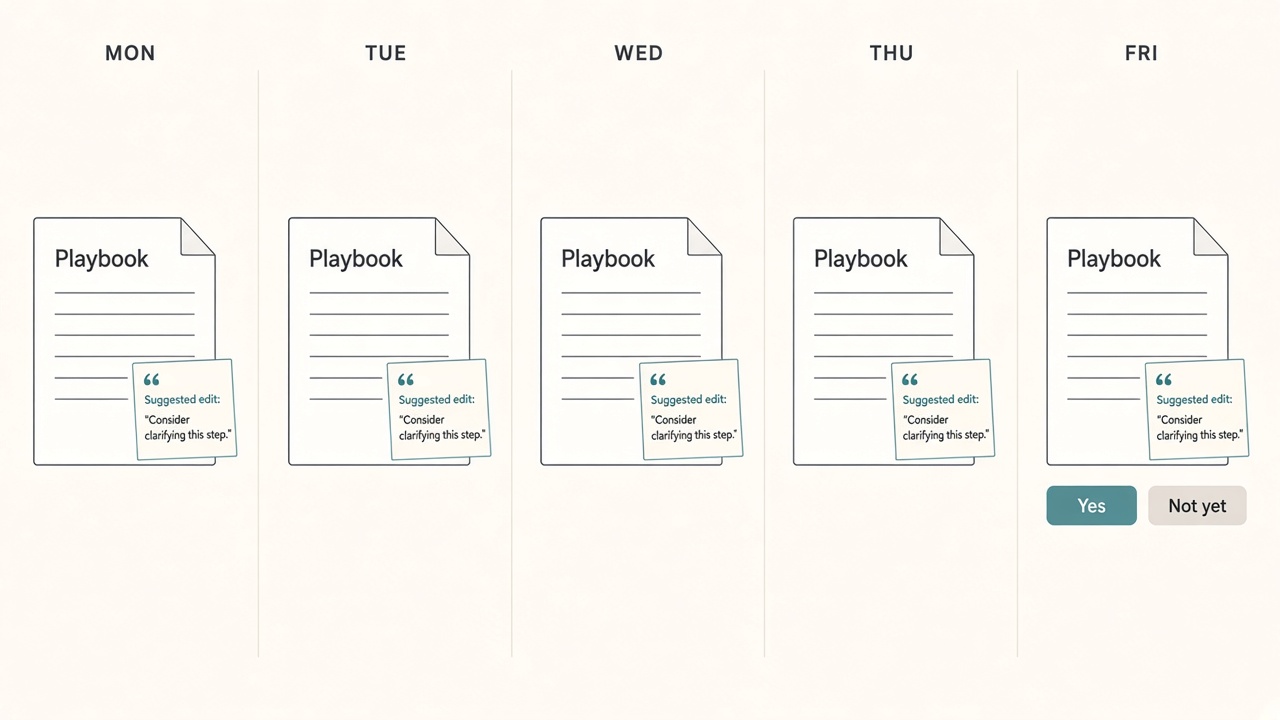
For about a month I’ve been piloting a fix on myself. My agents already read my meeting notes, my email and my chat. When they notice I’ve said the same new thing a few times, they propose a change to the file that governs it. The proposal reads something like: you’ve had three conversations this week about this change, should it be the new standard procedure? I say yes, the file gets rewritten, and from then on every agent works that way. Until I say yes, they keep following the file as it is.
The part I’d underline is that the agent proposes and a person decides. Every file has an owner, and a proposed change goes only to that owner. I own some files and other people own others. A short note shows up asking whether I’m OK with the change, and most of the time I answer in a few seconds. Sometimes the answer is “not yet, that’s not the final version,” and that’s useful too.
Repetition is what makes this work. One mention in a meeting isn’t policy. People think out loud, float ideas and change their minds by Friday. Imagine you’re a founder who says on one sales call that every pilot customer gets free onboarding. That’s a judgment call about one customer. Say it on three calls in a week and it’s starting to be how you sell, and it should probably be written down where your agents can find it. The agent’s job is to notice the pattern. Yours is to decide whether it’s real.
Keep the human part small
This only works if approving stays cheap. If every person on a team had to review hundreds of suggested edits, they’d stop reading them within a week and you’d be back to stale files. So I cap it. Once a week my agent gives me a handful of decisions, usually around six, and some of them aren’t even about the playbook. The goal is three to five fairly simple calls per person per week. At that size it fits in the gaps of a normal week, and the files stay current without anyone sitting down to rewrite documentation.
The setup is the annoying part, and I won’t pretend otherwise. The files have to live somewhere every tool can read, not inside any one AI product. Most of ours are plain text files with version history, so a bad edit is easy to roll back. The first line of our team’s AI instructions tells every agent to start at one table of contents that says where everything lives. Every file needs a named owner. That took real time to set up. Keeping it current takes a few minutes a week.
I built this for myself first, and we’re now rolling it out to the rest of AI House. So this is a month of my own use, not proof that it works for a whole team yet.
Where to start
You don’t need the whole system to try it. Pick one file your team’s AI already reads that you know is out of date, like your sales process or your onboarding checklist. Give it one owner. Once a week, have an agent read that week’s meeting notes and propose edits to just that file, with a quote for each one showing what it heard. Have it bring only the changes that came up more than once. Let the owner say yes or no, and cap it at a handful of decisions.
If the owner keeps saying yes, add a second file.